
Project summary
In this lab, I generated four safe PowerShell executions on a Windows 10 endpoint and used Sysmon + Wazuh to compare the events and review process creation telemetry.
PowerShell executions
I generated four safe PowerShell commands within a short time window:
powershell.exe -Command "Get-Process | Select-Object -First 5"
powershell.exe -NoProfile -ExecutionPolicy Bypass -Command "Test-NetConnection 192.168.20.55 -Port 1514"
powershell.exe -Command "Get-Service | Select-Object -First 5"
powershell.exe -Command "whoami; hostname; Get-Date"
Events in Wazuh
All four executions appeared in Wazuh under the same PowerShell-related detection family.
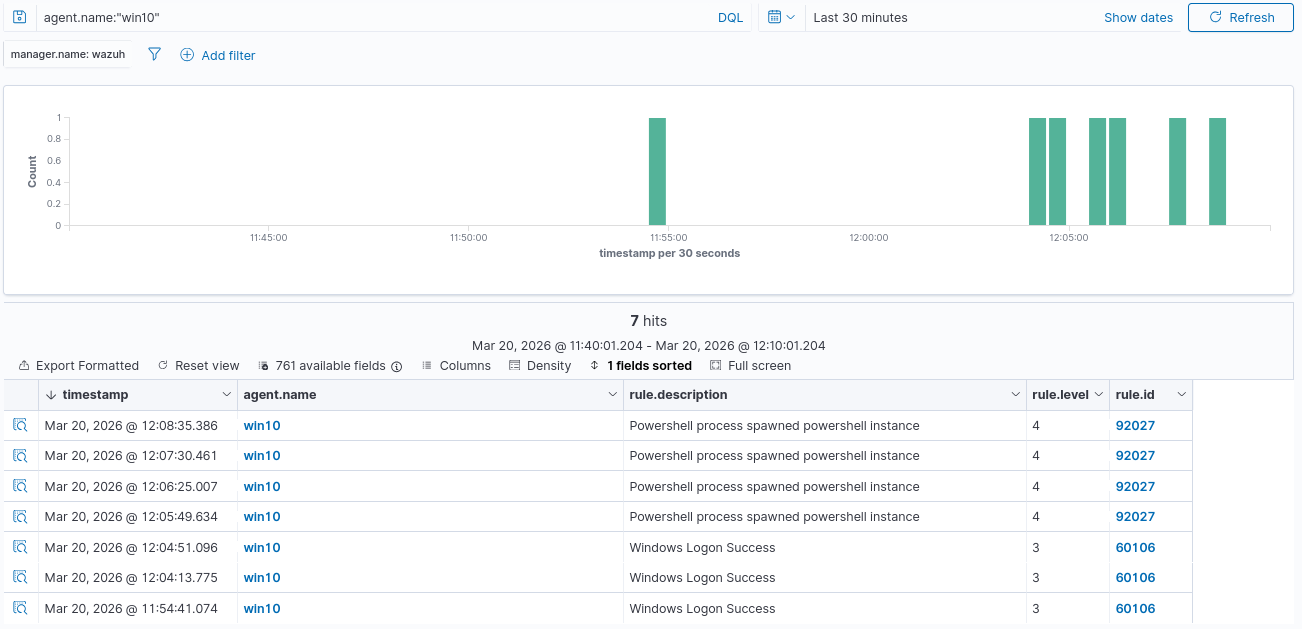
I compared the events using the command-line data recorded by Sysmon.
Event selected for analysis
I selected the following event for closer review:
powershell.exe -NoProfile -ExecutionPolicy Bypass -Command "Test-NetConnection 192.168.20.55 -Port 1514"
The execution stood out because it combined ExecutionPolicy Bypass with a connection attempt to 192.168.20.55:1514, while the other commands were simple administrative queries.
ExecutionPolicy Bypass increased the relevance of the event, but I did not treat it as evidence of malicious activity on its own. The review considered the command line, user, host, timestamp, and connection destination before placing the execution in context.
Sysmon evidence
In Wazuh, I reviewed the process creation event recorded by Sysmon.

The event recorded the full command line, including -NoProfile and -ExecutionPolicy Bypass, along with the associated user, host, and timestamp.
These fields made it possible to confirm which command had been executed and the context in which it occurred.
Conclusion
Comparing the four events helped identify an execution that warranted additional review because it combined ExecutionPolicy Bypass with a connection to 192.168.20.55:1514.
The Sysmon evidence validated the command and its context without indicating additional activity in the analyzed scenario.
generate the signal → compare events → review the evidence → add context → decide